Goodman’s much-anticipated production of The Who’s Tommy was as close to theatrical perfection as one can hope for – at least for a viewer like me who really loves rock operas.
The first musical I saw on Broadway was Tommy, and the sheer adrenaline of “Pinball Wizard” has always stayed with me. It was loud and colorful and built on an intensity of teenagers (at least singers and dancers playing teenagers) having an exhilarating experience. I couldn’t stand still in the lobby during intermission of that performance, and the same is true of the Goodman’s remounting, in which “Pinball Wizard” received a standing ovation on my second viewing.

Director Des McAnuff is no stranger to Tommy, having co-written the book with Pete Townsend and won the Tony award for directing the original Broadway production. McAnuff, notably, won his other Tony award for directing Jersey Boys, another rock musical that leaves the audience with an energy rush. What impressed me most about McAnuff’s updates at the Goodman was the emphasis on storytelling and the impact of projections in crafting Tommy into a piece that toes the line of several genres including historical drama and science fiction.
For those unfamiliar with the story, Tommy’s parents meet and quickly marry on the eve of the Battle of Britain. Captain Walker (Adam Jacobs) is shot down while on a mission, and Mrs. Walker (Alison Luff) is informed her husband is presumed dead. Four years later, Captain Walker returns to see his wife embracing a new lover. At altercation ensues in which Walker in self-defense shoots the lover, and the four-year-old Tommy’s trauma causes him to descend into a darkness, where he does not see, hear, or speak (hence his moniker of “that deaf, dumb, and blind kid.”)
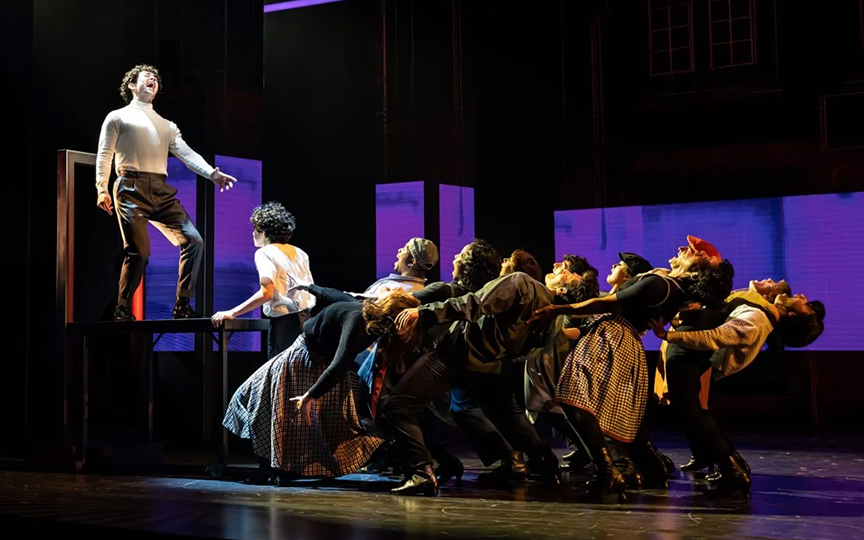
While every scene is Tommy is a spectacle, here are four that highlight the genius of this particular production:
- In “Christmas”, the chorus signs a hymn-inspired melody that connects the childhood joy of Christmas to the Walkers’ fear that the comatose Tommy (now nine years old) will be eternally damned for his inability to accept Jesus. Upon seeing a flicker of understanding from Tommy, Captain Walker sings a series of modulated versions of “Tommy can you hear me,” extenuated by Jacobs’s crystallin vocals. The result is an expression of the hope and despair that the Walkers endure every day.
- Leading up to “Sensation”, the sadistic Cousin Kevin (Bobby Conte) has brought Tommy to an arcade, where a group of teens entertain themselves by humiliating the unresponsive boy. On a whim, Kevin places Tommy in front of a pinball machine and pops in a quarter. To shock of his onlookers, Tommy plays and becomes a pinball champion. Ali Louis Bourzgui emerges as adult Tommy, standing on the machine while belting a song that guides his nine-year-old self (Annabel Finch at the performance I saw) to understanding what is happening in his closed mind. Choreographer Lorin Latarro dramatically heightens the scene with the chorus of teens inching closer and closer to the machine and then exploding backwards in a dance that illustrates their awe at experiencing this phenomenon.
- In “Smash the Mirror”, Luff’s vocals show Mrs. Walker hitting her breaking point after 15 years of devoting her life to Tommy’s condition. Unable to distract 19-year-old Tommy from looking at his own reflection in the mirror, she proclaims, “Do you hear or fear or / Do I smash the mirror?” When she does take a chair to the mirror, amazing projections first show a cracked glass tinged with Tommy’s signature yellow color. Next, a series of split-second images accompanying the rock score communicate the decimation of the inner walls that have imprisoned Tommy’s mind. Credit projection designer Peter Nigrini for the stunning effects.
- In connected reprisals of “I’m Free” and “Pinball Wizard”, we get more vocals from Bourzgui and the trio at the front of “Pinball Wizard” (Conte, Jeremiah Alsop and Mark Mitrano) along with transcendent direction as the scene flashes forward from 1960 to “the future.” In the time of a few bars of rock music, the costumes and sets change almost exclusively to gray tones. We are transported from a world of the past to a somewhat dystopian future, where Tommy’s followers maintain cult-like fanaticism.
There are too many highlights in Tommy to note them all, but a few others that must be mentioned are “Acid Queen”, the intense number featuring Christina Sajous as the drug-addicted healer Captain Walker almost entrusts with his son; “I Believe My Own Eyes”, an extraordinary duet in which the Walkers profess that their love for each other will be lost if they do not commit Tommy to an asylum; and, of course, “Pinball Wizard”, which stands as my choice for the greatest ending to a first act of any musical. Another fun detail to note is the designers subtle use of yellow. Most scenes include just one item of bright yellow for emphasis, whether it is the brochure from the mental institution, the frame of Tommy’s mirror, or even a single piece of clothing worn by a chorus member.

This is only the third production of Tommy that I have seen (the first in 1994), and that is probably because it simply cannot be downsized. Tommy needs the giant orchestra, elaborate sets, and energizing direction and choreography to make the material sour. Fortunately, the Goodman’s no-holds-barred approach to musicals is a perfect fit resulting in what will remain one of the best musicals to grace Chicago for years to come.
 theater in chicago reviews