My Favorite Musicals — #1 and #2

On Saturday, April 6, I drove 3 hours to Indianapolis to see Hadestown. This marked my 10th viewing in five different cities (New York, Chicago, Madison, Milwaukee, and Indy) in a little less than two-and-a-half years. On my return drive, I considered what makes Hadestown my “favorite musical.” I love the story, all of the songs, and the joy of watching different actors put their unique stamp on the leading roles, but that can be said about a number of musicals. The simplest explanation is that I connect with Hadestown in an way that is greater from the any other musical that I have seen.

In honor of my Hadestown anniversary (and another anniversary since this is my 100th blog post), I have decided to start a series about the musicals that have had the greatest impact on me. I will begin by writing about my five favorite musicals emphasizing memories of my first viewing, the deep connections I make with the characters, and the moments that I eagerly anticipate whenever I am fortune enough to catch a production.

#1 – Hadestown

Eva Noblezada, André De Shields, and Reeve Carney from the original Broadway cast

Hadestown was one of the first musicals to reopen on Broadway after more than a year of darkness due to the COVID pandemic, and I hopped on a plane to see it knowing only a few facts: (1) it had won the Tony award for Best Musical, (2) it’s plot is rooted in Greek mythology, (3) and André De Shields was earning rave reviews as Hermes. Hadestown hooks the audience right at the start. Hermes walks across the stage in a sparkling suit, quietly connecting with each of his fellow actors, and then he asks the audience to acknowledge that we are “all right!” From there, the overture begins with a rousing trombone solo.

I often paraphrase an insightful line from Urinetown: “Nothing kills a musical like too much exposition.” Hadestown accomplishes the unique feat of presenting all of its exposition in the opening song “Road to Hell” and then quickly jumps into the blossoming love of Orpheus and Eurydice, which is soon contrasted by the faded love felt by Hades and Persephone. Both relationships elicit a complete spectrum of emotions before culminating in their inevitable conclusions. I’ve dismissed many musicals over the years because the writers fail to convincingly convey love, but with Hadestown I continue to hope that maybe the story will turn out differently on a new viewing, a theme that composer Anaïs Mitchell explores in the “Road to Hell” reprise when Hermes declares that the outcome is a “sad song, but we’re going to sing it again.”

My favorite moment in Hadestown (maybe my favorite moment in all musical theater) is the start of “Wait for Me.” The song is a true masterpiece, combining intense spoken word poetry from Hermes with two anthems from Orpheus – the impassioned “Wait for Me” chorus and the melody beautiful enough to open the walls of Hell. Two additional highlights are “Way Down Hadestown” for its joyous choreography and “Why We Build the Wall” with Hades’ deep-barratone message being echoed by the chorus.

#2 – Pippin

Patina Miller, Terrence Mann, and Matthew James Thomas from the 2013 Broadway revival cast

Unlike Hadestown, I was familiar with some of the songs from Pippin before I first saw the musical – they were often performed during my two-year show choir stint in the mid-90’s. Yet, Pippin (which debuted under Bob Fosse’s direction in 1972) was no longer on the regular performance circuit when I started seeing musicals in the mid-80’s possibly due to very racy lyrics and choreography. My first viewing was the acclaimed 2013 Broadway revival, which enhanced the storyline with an ensemble of acrobats. By the end of this version (which I managed to see three times between New York and Chicago), I could not imagine Pippin without the circus feats, but I have since learned that Pippin is just as enjoyable when done minimally, like the 2018 production in the Mercury Theater’s cabaret space.

While “Magic to Do” is an exciting opening that establishes a direction for the next two hours, Pippin really gets started with the first notes of “Corner of the Sky,” and I remember the beginning of Mathew James Thomas’s Broadway performance in 2013 – his voice expanding like crystal through the theater when he hits the chorus: “Rivers belong where they can ramble. Eagles belong where they can fly.” Pippin is a highly relatable character as he searches for a purpose in life – a path to finding inner contentment with no idea where to start. His father Charlemagne expects Pippin to use tyranny to establish power. His grandmother Berthe encourages Pippin to enjoy life in the always fun sing-along “No Time at All.” In one of the great Act I finales – “Morning Glow” – Pippin tries to find meaning by establishing peace. When the lead player and his troop expect Pippin to sacrifice his life in a climactic spectacle, Pippin refuses.

Hadestown and Pippin share two notable qualities. They both present characters from long ago (mythical and historical) in modern settings, emphasizing the timelessness of their struggles. Also, both involve characters who embark on a physical quest (Pippin throughout Europe / Orpheus down to the underworld), but the challenges they must overcome are more internal than external.

#3 and #4 – Preview

I originally planned to write about all five of my favorite musicals in one post before realizing that post would be far too long. Therefore, in a homage to the method that Aurora’s Paramount Theater presents its upcoming seasons, I am going to release a preview. See if you can guess the next two musicals based on the following sets of emojis. I hope to publish my 101st post soon.

My Favorite Musicals — #1 and #2

Great Broadway Solos (sung by women)

Few experiences in musical theater can match the exhilaration felt by the audience and the performer during a remarkable solo. The best of solos – the true upper-echelon – provide a deep insight into not only the character’s mind but also the unique world in which he/she lives.

For this blog, I am going to focus on some of the best solos in which female performers put everything on the line. They are experiencing some form of crisis, and by the end of the song the character’s inner turmoil reverberates through our brains as much as the song’s melody. Some of these songs are recognized Broadway canon, but a few are more unique to my tastes and memories.

#7 – “Acid Queen” (The Who’s Tommy)

What it’s about: desperation and addiction

I could not find any quality photos from “Acid Queen” in the original Broadway run, but I do vividly remember the Gypsy’s bright yellow dress.

The Who’s Tommy was my first Broadway musical, an interesting choice for a sheltered middle-schooler more familiar with REO Speedwagon than The Who. I don’t remember if I even knew what “dropping acid” meant when I walked into the theater, but I sure knew by the number’s end as the silhouetted Gypsy shoots heroine into her arm. At intermission I peppered my mother with questions about how “Acid Queen” fit into the plot, and she responded, “In the 60’s, some people just liked to write songs about drugs.” Years later, as I found myself listening to this song on near repeat (maybe even belting along when I was alone), I realized that the greatness of “Acid Queen” is that the performer’s manic intensity is an embodiment of the character’s addiction. The Gypsy needs Captain Walker’s money, and to get it she is willing to “tear [Tommy’s] soul apart.” “Acid Queen” is the Gypsy’s only song, yet it serves as the rock bottom of the psychedelic experience that is Tommy’s journey.

#6 – “I’m Still Here” (Follies)

What it’s about: persevering in the long game

Polly Bergen’s performance as Carlotta is immortalized in her performance at the 2001 Tony awards. The main link (which is the full song) is from the Drama Desk Awards.

The 2001 Tony Awards were dominated by The Producers, which set the record by winning 12 Tony Awards, a sweep of every musical category except Leading Actress. However, I contend that amid all the hype was one of the greatest gaffs in Tony Awards history. Namely, the late Polly Bergen should have beaten The Producers and won Best Featured Actress in a Musical for her performance of “I’m Still Here” in the Roundabout revival of Follies. As the title implies, “I’m Still Here” is a tour-de-force number. Sung by the character Carlotta Campion, the aging actress tells the story of career setbacks and humiliations articulated by some of Stephen Sondheim’s most glorious lyrics (“First you’re another sloe-eyed vamp / then someone’s mother, then you’re camp”), and ultimately her success is attributed to the fact that she relied on no one but herself. Bergen’s performance was a lightening-in-a-bottle moment followed of waves of applause that started thunderous, then died down before reigniting multiple times, ending only after Bergen signaled her exit stage right.

#5 – “Music and the Mirror” (A Chorus Line)

What it’s about: needing a chance

Broadway veteran Charlotte d’Amboise gave a commanding performance as Cassie in the 2006 revival. The full 10-minute scene is linked.

A number of moving parts contribute to the anticipation of “Music and the Mirror.” Subtle inferences that Zack and Cassie have a troubled past build to a fever pitch when the two finally share a dialogue. With Cassie exposed on center stage and Zack unseen from his director’s booth, Cassie is forced to beg just to continue her audition: “I need a job. I need a job and I don’t know any other way to say it. Do you want me to say it again?” Once the music begins, an actress must convey the desperation of the lyrics (“Put me to work, you would think that by now I’m allowed. I’ll do you proud.”) over the increasingly intense trumpet flourishes and drum licks. Other characters in A Chorus Line sing about their love for dancing, but Cassie is in a higher plane: her need to dance is expressed in every step of the 5-minute dance solo. As a character, Cassie is extremely vulnerable, but when she dances she takes full control of the stage.

#4 – “The Ladies Who Lunch” (Company)

What it’s about: existential crisis

Patti LuPone performed as Joanne in the 2011 filmed version of Company, which also starred Neil Patrick Harris as Bobby.

My first exposure to this Sondheim classic from 1970 was, unfortunately, in the form of the Forbidden Broadway parody “The Ladies Who Screech,” which is more obnoxious than funny (although Elaine Stritch’s rendition does become a bit screechy). What I have since discovered is that the extended belting at the end of the song (“Everybody rise. Rise. Rise, rise.”) is the musical embodiment of how Joanne perceives her own existence – she is bored, trapped in a tedious life with little to drink to beyond wealthy women who hide their own banality by shopping and taking art classes and (of course) meeting for lunch. The lyrics for “The Ladies Who Lunch” provide opportunity for each actress to tell a unique story. The best interpretation belongs to Patti LuPone, but don’t discount the Camp version in which a teenaged Anna Kendrick accentuates her anger by shattering her own martini glass.

#3 – “No Good Deed” (Wicked)

What it’s about: the dark side of human nature

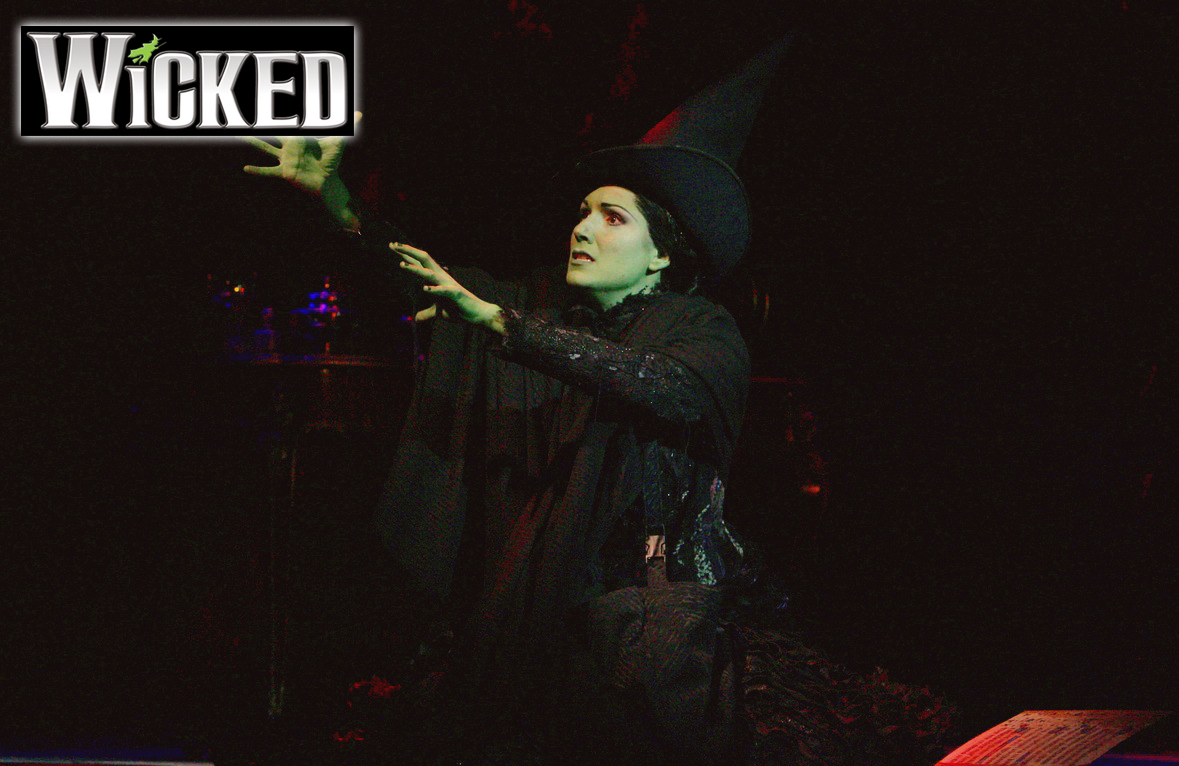
I have seen many actresses perform Elphaba, and Stephanie J. Block was my favorite. She is seen here reading from the Grimmerie during “No Good Deed.” The main link is Shoshana Bean performing.

The first act of Wicked focuses heavily on plot development, moving from Elphaba’s birth to her renunciation of the Wizard. The second act of Wicked slows the pace and emphasizes Elphaba’s internal struggles as she becomes The Wicked Witch, and the anchor of that second act is “No Good Deed.” Beginning with a rhythmic chant of magical words, the song lulls the audience into Elphaba’s turmoil before Stephen Schwartz’s lyrics expose the frustrations of her failures. When Elphaba sings, “One question haunts and hurts / Too much, too much to mention. / Was I really seeking good / Or just seeking attention?” Schwartz manages an ingenious summary for Gregory Maguire’s novel. The musical is lighter in tone than its source material, but “No Good Deed” creates a momentary glimpse into the question surrounding Elphaba’s life: was she predestined toward wickedness, or is her wickedness a result of her own actions? For both melody and emotional impact, “No Good Deed” is the best song in Wicked – greater even than the more popular “Defying Gravity.”

#2 – “I Have Four Children” (Caroline, or Change)

What it’s about: working hard but still getting nowhere

Tanya Pinkins starred in the original 2004 production of Carline, or Change, taking on one of the most physically and emotionally grueling roles in musical theater.

On my last viewing of Caroline, or Change, a brilliant 2018 collaboration by Timeline and Firebrand theater companies, I had a distinct lyric in my head at the start of intermission and even at the end of the show. Anchored by a rhythm reminiscent of the repetition of a basement dryer, Caroline sings, “And I am mean and I am tough but…/ Thirty dollars ain’t enough./ Thirty dollars ain’t enough.” This is an anthem for Caroline Thibodeaux, a maid in 1963 Louisiana struggling to support three children on her dismal salary (her oldest son is in Vietnam). This opening song with lyrics by Tony Kushner and music by Jeanine Tesori combines the soul of blues and the rigors of opera. Caroline’s tribulation is to hold tightly to a world which stacks the odds against her while knowing that she cannot last much longer. Caroline is one of the most difficult parts in any musical, and I have been very fortunate to see Tonya Pinkins (2004), E. Faye Butler (2008) and Rashada Dawan (2018) each excel in the role.

#1 – “Cabaret” (Cabaret)

What it’s about: making a definitive choice

Kelly Felthous starred in Paramount Theater’s exceptional 2018 production of Cabaret. The main link features the late Natasha Richardson in a rendition of “Cabaret” that demonstrates the depth and versatility of the titular song.

I remember the awe I felt upon seeing the song “Cabaret” performed live for the first time. This was the 1998 Broadway revival at Studio 54 and Molly Ringwald (performing in 2002) was one of many capable actresses to step into the role of Sally Bowles. I was well acquainted with the song and understood it to be a celebration of life: “Come taste the wine, / Come hear the band./ Come blow a horn,/ Start celebrating;/ Right this way, your table’s waiting.” In fact, Liza Minnelli’s movie performance (directed by Bob Fosse) is an ode to exuberance. Imagine my shock upon seeing that this number had been completely turned on its head for the revival. Gone was the carefree ignorance of the growing Nazi presence. It was replaced by Sally clinging to her last thread. The world is crashing around her, and suddenly the morbidity of a song about a deceased prostitute/roommate is foreshadowing the oncoming destruction – a calamity that Sally is unlikely to survive. The magic of “Cabaret” is that the song is remarkable either way. It can be a boisterous drinking song or a sad commentary about futility.

Thanks for reading. Theater was all but nullified for most of 2020, but I am hopeful that the arts will make a slow reemergence in 2021. If you have other favorite female solos, post them in the chat. I am planning on posting in the near future a similar blog featuring favorite male solos.

Great Broadway Solos (sung by women)