The Paramount Theater made a fitting choice for the inaugural play of their new Bold series at the Copley*, which is a small venue across the street from their much larger playhouse in downtown Aurora. Sweat won the 2017 Pulitzer Prize for its insightful examination of factors that have contributed to the polarization of America. Its characters and themes were very relevant during its Chicago premier at the Goodman in 2019, and (sadly) they feel even more relevant today.
Shariba Rivers (Cynthia), Randy Steinmeyer (Stan) & Tiffany Bedwell (Jessie)
Anthony Doerr’s novel All the Light We Cannot See includes the best representation of love that I have ever read in a novel. The two main characters—a 16-year-old blind French girl and an 18-year-old German soldier—meet In Saint-Malo, France, after traversing each other’s paths for the entirety of World War 2. Marie-Laure and Werner are together for only a few hours after being trapped for days in near-death experiences. With each rereading, I always hope the conclusion of the scene will be different—the words in the book will change, and my memory of the actual ending will somehow be wrong. That is how much Doerr has made me care about these fictional characters and their bond.
Published by AmFrederick on DeviantArt.
I experienced this same emotion in the Walter Kerr Theater while watching Hadestown. One decision I have made as a theater-goer is to learn as little as possible about a play before seeing it. I do not listen to the albums or watch clips online or read summaries of the plot because nothing can recreate the lasting impact of something unexpected on the stage. In the case of Hadestown, the moment I will always remember is the dramatic shift from a beautiful song to complete silence.
In this post I am going to declare the winners for the remaining four first-round pairings. My previous post explains the methodology I used to choose these 16 musicals as candidates for the best Tony-nominated musical of the 2010-2019 decade. If you would like to hear me explain my choices for each pairing, check out this video.
The way I remember it, I am eight years old and playing Nintendo one Saturday morning when my father walks down the basement stairs to tell me about the play he and my mother saw the previous evening. He refers to the title as Say Yes, Pablo and notes that the play was supposed to be about Pablo Picasso but it was not really about anything, and in the place of normal dialogue there was a lot of chanting. He also said that 25 minutes into the show the first audience members exited out the back door, and the steady flow of unhappy patrons kept that back door open until the end.
Say Yes, Pablo holds a special meaing in our family. When we see a play that we really dislike, we say, “Well, at least it was better than Say Yes, Pablo.”
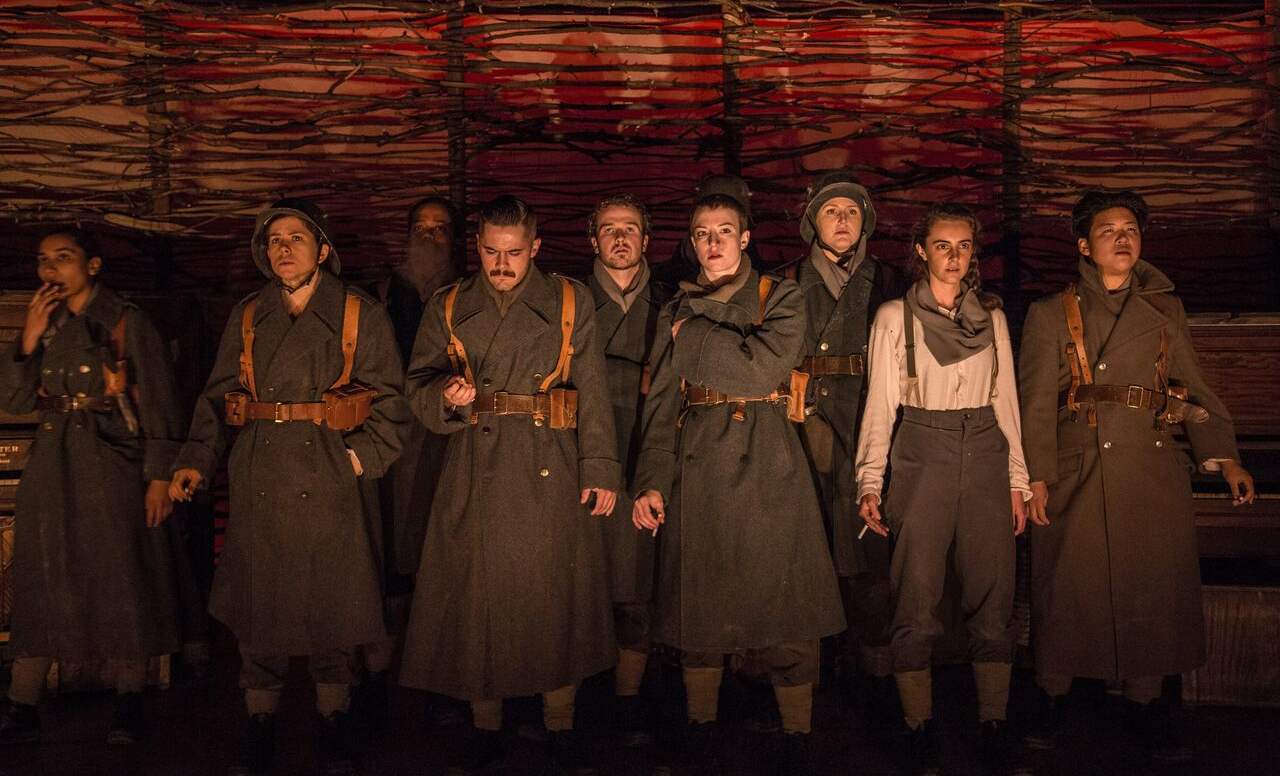
The gender-blind cast of All Quiet on the Western Front
The script by Matt Foss is a tribute to Erich Maria Remargue’s novel—a no-holds-barred criticism of war as seen through the eyes of WW1 soldiers, who have accepted that their survival means nothing to the unseen figures calling the shots. Elena Victoria Feliz as Paul moves through the most inventive staging of the year—war is played out on top of old pianos, and colored powders communicate the impact of bombs and bullets.
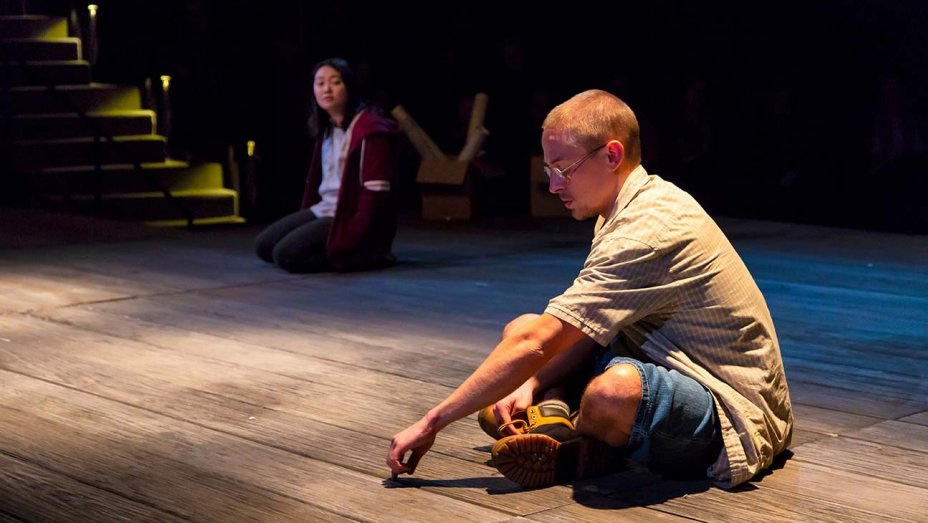
Samuel Hunter sits among my favorite playwrights based on the strength of The Whale and Pocatello. One can make a sure bet that a Hunter play will build to a mesmerizing, semi-tragic climax as characters push themselves beyond their own limitations.
The Niceties is a dramatic tennis match of ideas with two characters scoring points in their increasingly intense back-and-forth exchanges.
Janine (Mary Beth Fisher)—a respected history professor teaching an upper-level course on revolutions—begins by offering criticisms to Zoe (Ayanna Bria Bakari) regarding her 20-page thesis essay. The ensuing discussion is fraught with conflicts framed by both race and the generation gap between Baby Boomers and Millennials. Before the play’s start, a Writer’s Theater Associate encouraged the audience to consider both points of view—particularly when we felt a strong allegiance to one character’s perspective. In that spirit, I am going to present my reactions to The Niceties by referencing the more convincing points scores by both Janine and Zoe.
With The Recommendation, Windy City Playhouse solidifies itself as a theater company at the forefront of immersive theater.
Julian Hester and Michael Aaron Pogue
I admit that I was more dismissive than intrigued in early 2018 when the Playhouse started promoting Southern Gothic. The experience promised to take theatergoers into the heart of a Southern dinner party in the 1960’s. Immersive theater? I kept picturing moments from Cats when actors walk into the aisles and start rubbing their heads against patrons’ bodies.*
Mary Shelley’s Frankenstein and Bloomsday are two literary adaptions which might seem diametrically opposed in subject matter, yet their prominent similarity is they both prove the importance of capturing the respective tones of their source material.
Walter Briggs (Percy Shelley and Dr. Frankenstein), Cordelia Dewdney (Mary Shelley and Elizabeth) & Debo Balogun (Dr. John Polidori)
Frankenstein, produced at Lookingglass with the company’s usual emphasis on staging, plays with the conceit that the non-fiction behind the novel could induce more chills than the ubiquitous story of a mad scientist and the life he creates. The origins of Mary Shelley’s novel are well known, and the play begins in a cramped but lush sitting room with five affluent pre-Victorians killing boredom with a contest to see who could tell the best ghost story. Using the same theatrical technique as the musical Man of La Mancha, Mary Shelley (Cordelia Dewdney) and her four listeners begin to perform her tale. Bits of the “actors ” egos and insecurities add depth to their play within the play.
Back in the winter of 2014, I was entranced by Chicago Shakespeare’s production of Pericles. The play follows a cast of characters (Pericles, Prince of Tyre, among them) as they voyage around the Greek islands. There are death sentences, murder plots, shipwrecks, pirates, mistaken identities. David H. Bell’s production played out like a modern adventure film set within the soft, aquatic colors of ancient Greece.
I bring up Pericles mostly to explore a question: how do we choose which of Shakespeare’s plays are “cannon” and which are “the lesser works”? The website shakespearences.com has made a study of logging the regularity with which Shakespeare’s works are produced. A Midsummer Night’s Dream, Romeo and Juliet and Hamlet are ranked as the top three—Pericles is right in the middle at 24, underneath the prominent comedies and tragedies and above most of the histories.




 theater in chicago reviews