My first viewing of Chess was a community theater production. My second viewing was the filmed concert version starring Josh Grobin, Idina Mentzel, and Adam Pascal. Having not particularly enjoyed either of those productions, I was skeptical that there would be much for me to enjoy in this Broadway revival of a musical that is notorious for failed script rewrites.
Screenwriter Danny Strong, whose most notable accomplishment is the fantastic Hulu Dopesick series, finally created a script that audiences can love based on a critical change: he acknowledged that a lot of what is happening on stage is ridiculous (even if some of it is true).
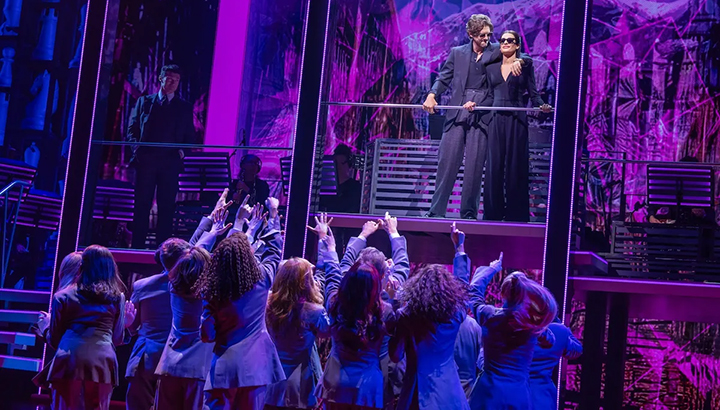
Aaron Tveit & Lea Michelle (upper right) and the ensemble
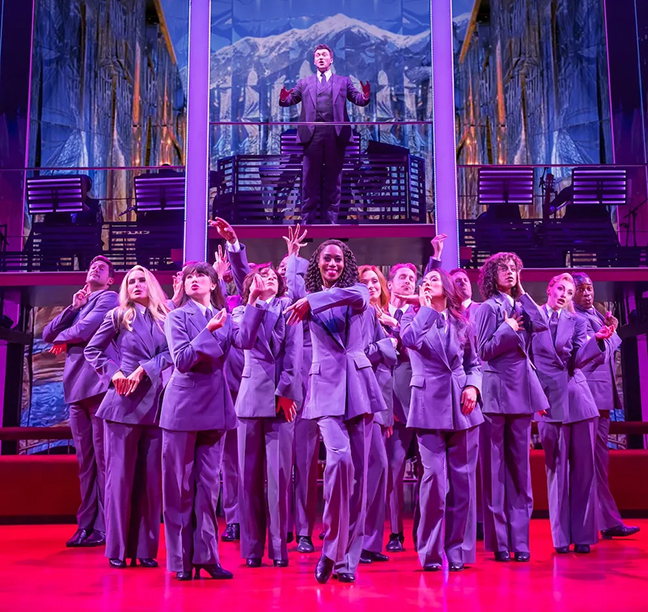
Strong has added a narrator (Bryce Pinkham, who doubles as the arbiter for the chess games) and a Greek chorus dressed in matching tailored suits. With the narrator comes the second significant improvement in Strong’s script: the audience can follow the plot, which involves the CIA and the KGB attempting to manipulate the main characters to accomplish Cold War objectives. It all plays out much like a chess game in which lesser pieces are sacrificed for the greater goals. I’m sure the previous scripts also played on the parallels between Cold War objectives and a game of chess, but this new version manages to make that metaphor work.
Bryce Pinkham (upper center) and the ensemble
Everything else delivered on what one would expect from a Broadway revival—energized choreography, an ingenious set, and top-notch belting of the ballads from leads Lea Michaelle, Aaron Tevit, and Nicholas Christopher. Yet, it is the new script that makes me hope this production tours, so I can experience it at least once more.
Ragtime
In the book Razzle Dazzle, Michael Reidel provides an in-depth examination of how a promising show like Ragtime managed to underperform in its original Broadway run despite possessing all the ingredients for much greater success. Among other errors, the producers underestimated The Lion King, which also debuted in 1997-98 season and has lived on to become the most profitable Broadway show of all time.
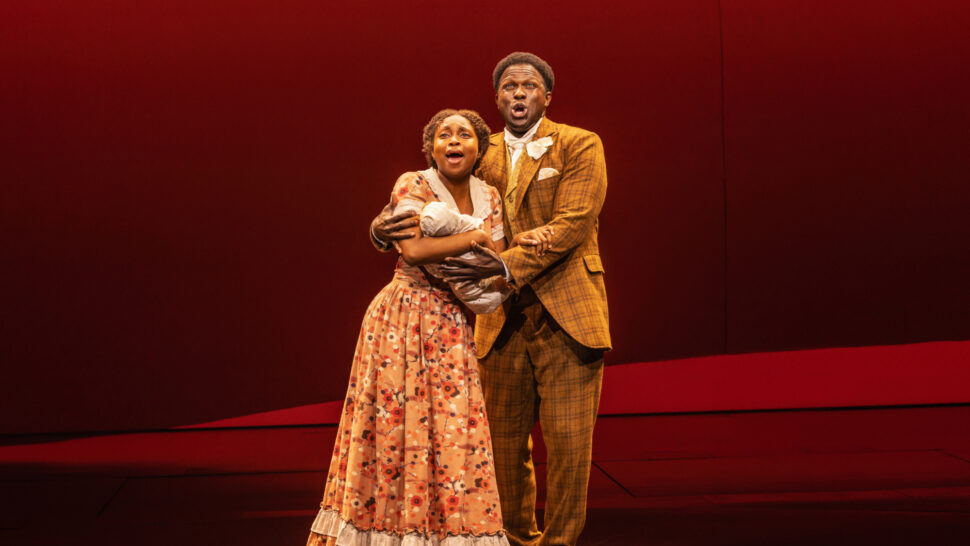
Nichelle Lewis & Joshua Henry performing “Wheels of a Dream”
Whatever mistakes were made 28 years ago were not repeated in 2025 – Ragtime is one of the hottest tickets of the season and is a frontrunner to win a long-overdue Best Musical Tony (albeit for Revival). Much of the success for any Ragtime production sits squarely on the singing chops for the actor playing Colehouse Walker, and Joshua Henry is a true powerhouse. In fact, he received a first-act standing ovation following his rendition of “Wings of a Dream.” Yet, for me the highlight of Ragtime is not any one song or performer but instead the ways that the script merges its characters to tell the story of America.
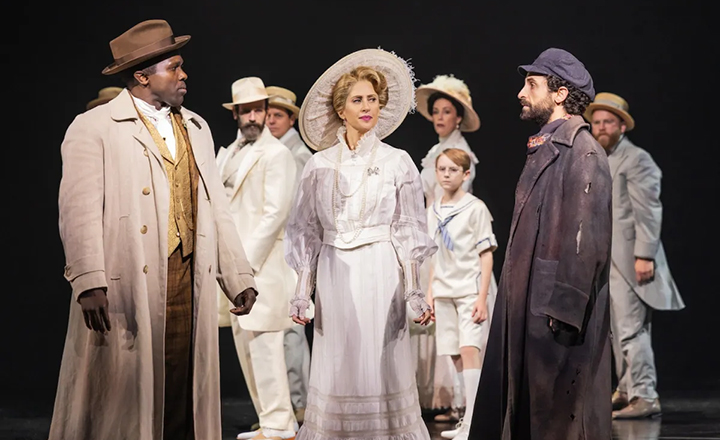
Foreground: Joshua Henry (Colehouse Walker), Caissie Levy (Mother) & Brandon Uranowitz (Tateh)
Much of the conflict in Ragtime stems from the clashing of the three groups presented in the opening number: the wealthy white citizens of New Roselle, the immigrants landing at Ellis Island, and the African-Americans from Harlem. Certain moments remain deeply disturbing to watch—the vandalization of Colehouse’s scene and propositioning of Tateh’s daughter, to name two. But there is also great hope in Ragtime—maybe the people in our divided society can look past differences and find unity.
Many have connected this revival to political events, calling this “the right show for this time.” I would argue that, current events aside, Ragtime more than any other musical represents America—past and present.
Evan Tyrone Martin (Pierre, standing on the table) and the cast
I enjoyed this musical when I saw it on Broadway in 2017, but this production from Writers Theater launched Natasha, Pierre… into my list of all-time favorite musicals. Set within the world of aristocratic Russian society in 1812, every song overflows with the passions of characters who are fully committed to their causes, whether they strive to marry well, fabricate a scandal, seduce a young woman, or find meaning in the universe. Director and choreographer Katie Spelman led a cast with too many stars to name here – I’ll limit myself to praising Evan Tyrone Martin, who, as Pierre, accentuated the nuances of a character who shifted from hopelessness to action in Natasha’s (Aurora Penepacker) time of need. Year after year, Writers Theater rises to the top with their intimate stagings of large-scale musicals. Video montage
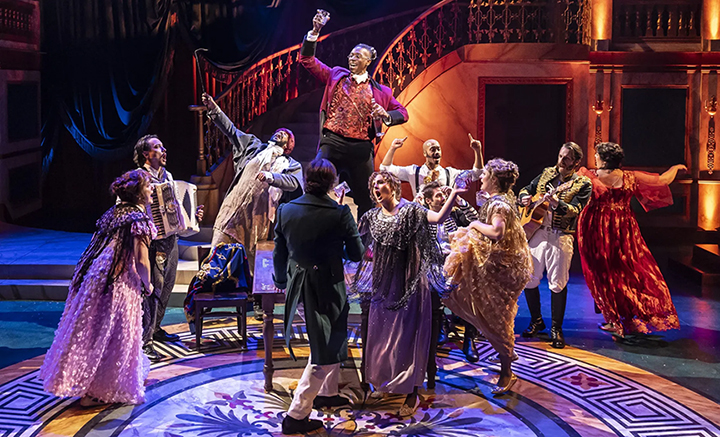
J. Harrison Ghee (Lady Chablis, standing tallest in the middle) and the cast
When the Goodman announced that J. Harrison Ghee (Tony winner from Some Like it Hot) would play Lady Chablis, I knew they were on the right track. Ghee’s entrance did not disappoint as she waved away the applause and insisted to the audience, “Make me earn it.” Adapting this 1994 bestseller into a musical is no easy task, but the script by Taylor Mac and the music by Jason Robert Brown embodied the mysteries, contradictions, and joys of Savannah. Brown’s use of different musical styles for each main characters’ songs added depth to their characterizations, and the choreography by Tanya Birl-Torres was another bonus. Producers have announced that Midnight… will open on Broadway in 2025, but as of yet no theater or opening date is set. Video scene
On Saturday, April 6, I drove 3 hours to Indianapolis to see Hadestown. This marked my 10th viewing in five different cities (New York, Chicago, Madison, Milwaukee, and Indy) in a little less than two-and-a-half years. On my return drive, I considered what makes Hadestown my “favorite musical.” I love the story, all of the songs, and the joy of watching different actors put their unique stamp on the leading roles, but that can be said about a number of musicals. The simplest explanation is that I connect with Hadestown in an way that is greater from the any other musical that I have seen.
In honor of my Hadestown anniversary (and another anniversary since this is my 100th blog post), I have decided to start a series about the musicals that have had the greatest impact on me. I will begin by writing about my five favorite musicals emphasizing memories of my first viewing, the deep connections I make with the characters, and the moments that I eagerly anticipate whenever I am fortune enough to catch a production.
#1 – Hadestown
Eva Noblezada, André De Shields, and Reeve Carney from the original Broadway cast
Hadestown was one of the first musicals to reopen on Broadway after more than a year of darkness due to the COVID pandemic, and I hopped on a plane to see it knowing only a few facts: (1) it had won the Tony award for Best Musical, (2) it’s plot is rooted in Greek mythology, (3) and André De Shields was earning rave reviews as Hermes. Hadestown hooks the audience right at the start. Hermes walks across the stage in a sparkling suit, quietly connecting with each of his fellow actors, and then he asks the audience to acknowledge that we are “all right!” From there, the overture begins with a rousing trombone solo.
I often paraphrase an insightful line from Urinetown: “Nothing kills a musical like too much exposition.” Hadestown accomplishes the unique feat of presenting all of its exposition in the opening song “Road to Hell” and then quickly jumps into the blossoming love of Orpheus and Eurydice, which is soon contrasted by the faded love felt by Hades and Persephone. Both relationships elicit a complete spectrum of emotions before culminating in their inevitable conclusions. I’ve dismissed many musicals over the years because the writers fail to convincingly convey love, but with Hadestown I continue to hope that maybe the story will turn out differently on a new viewing, a theme that composer Anaïs Mitchell explores in the “Road to Hell” reprise when Hermes declares that the outcome is a “sad song, but we’re going to sing it again.”
My favorite moment in Hadestown (maybe my favorite moment in all musical theater) is the start of “Wait for Me.” The song is a true masterpiece, combining intense spoken word poetry from Hermes with two anthems from Orpheus – the impassioned “Wait for Me” chorus and the melody beautiful enough to open the walls of Hell. Two additional highlights are “Way Down Hadestown” for its joyous choreography and “Why We Build the Wall” with Hades’ deep-barratone message being echoed by the chorus.
#2 – Pippin
Patina Miller, Terrence Mann, and Matthew James Thomas from the 2013 Broadway revival cast
Unlike Hadestown, I was familiar with some of the songs from Pippin before I first saw the musical – they were often performed during my two-year show choir stint in the mid-90’s. Yet, Pippin (which debuted under Bob Fosse’s direction in 1972) was no longer on the regular performance circuit when I started seeing musicals in the mid-80’s possibly due to very racy lyrics and choreography. My first viewing was the acclaimed 2013 Broadway revival, which enhanced the storyline with an ensemble of acrobats. By the end of this version (which I managed to see three times between New York and Chicago), I could not imagine Pippin without the circus feats, but I have since learned that Pippin is just as enjoyable when done minimally, like the 2018 production in the Mercury Theater’s cabaret space.
While “Magic to Do” is an exciting opening that establishes a direction for the next two hours, Pippin really gets started with the first notes of “Corner of the Sky,” and I remember the beginning of Mathew James Thomas’s Broadway performance in 2013 – his voice expanding like crystal through the theater when he hits the chorus: “Rivers belong where they can ramble. Eagles belong where they can fly.” Pippin is a highly relatable character as he searches for a purpose in life – a path to finding inner contentment with no idea where to start. His father Charlemagne expects Pippin to use tyranny to establish power. His grandmother Berthe encourages Pippin to enjoy life in the always fun sing-along “No Time at All.” In one of the great Act I finales – “Morning Glow” – Pippin tries to find meaning by establishing peace. When the lead player and his troop expect Pippin to sacrifice his life in a climactic spectacle, Pippin refuses.
Hadestown and Pippin share two notable qualities. They both present characters from long ago (mythical and historical) in modern settings, emphasizing the timelessness of their struggles. Also, both involve characters who embark on a physical quest (Pippin throughout Europe / Orpheus down to the underworld), but the challenges they must overcome are more internal than external.
#3 and #4 – Preview
I originally planned to write about all five of my favorite musicals in one post before realizing that post would be far too long. Therefore, in a homage to the method that Aurora’s Paramount Theater presents its upcoming seasons, I am going to release a preview. See if you can guess the next two musicals based on the following sets of emojis. I hope to publish my 101st post soon.
The cast was led by Ali Louis Bourzgui (Tommy), Alison Luff (Mrs. Walker) & Adam Jacobs (Captain Walker)
There are so many incredible aspects of The Who’s Tommy to discuss (the lead actors, the ensemble, the choreography, the lighting effects – to name a few) that one forgets what a high-stakes gamble this must have been for the Goodman Theater’s new Artistic Director Susan V. Booth. Original Broadway director Des McAnuff’s reimagining of this rarely-performed rock opera earned nine Jeff awards, set new box-office records for the Goodman, and secured a Broadway production beginning March 8. It was truly a sensation from start to finish.
My list of the top 10 musicals of 2022 is a little belated. Note that I focused on Chicago-based productions, but this was also an outstanding year from Broadway-in-Chicago with traveling companies of Hadestown and Come From Away visiting early in the year, and Six holding a residency for several months at the CIBC.
In the opening scene of director Barrie Kosky’s production (which he originated in Berlin), a modern American boy opens his bedroom closet to find not just Tevye but the entire tremendous cast stream through a set of double doors onto the crowded stage. The impact is a masterful articulation of the way that Fiddler connects the decedents of immigrants to the cultural hardships their ancestors reluctantly left behind. Steven Skybell as Tevye led an outstanding cast, and set designer Rufus Didwiszuz created the most memorable effect I can even remember viewing by covering the vast Lyric Opera stage with snow for the second act.
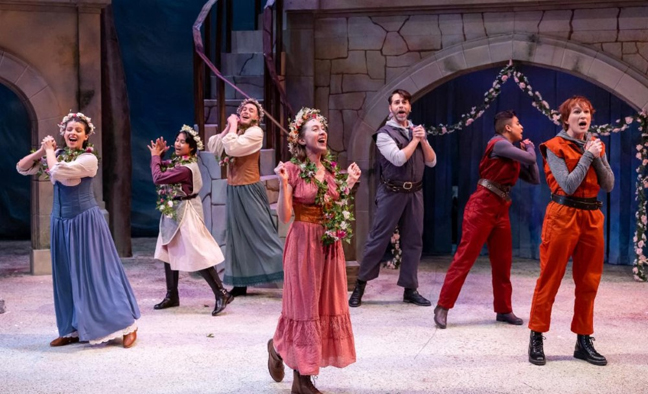
The version of Camelot currently being produced by Musical Theater Works is an experiment in evolving old-school musicals. Other productions of Camelot that I have seen have always involved large casts and long run times. In fact, a 2012 staging by Light Opera Works (which became Music Theater Works several years ago) ran over three hours despite cutting “Fie on Goodness!”—one of my favorite songs. The current version playing at the Center for Performing Arts in Skokie is just under two hours and features a minimal cast of just nine actors.
The origins of this version of Camelot date back to 2014, when New York director David Lee revised the script condensing almost all of the exposition to sentences narrated by various cast members. The philosophy is that the strength of Camelot is the songs by Lerner and Loewe, while its original book (also by Lerner) is bogged down with too much Arthurian lore. Does this version work? Yes, in many ways it does.
Christine Mayland Perkins (Guenevere) and the rest of the cast minus Arthur and Lancelot perform “The Lusty Month of May.”
I’ll begin with the disclaimer that this comparison of productions of Godspell and Jesus Christ Superstar might imply a strong bias for Chicago’s storefront theaters over the Broadway in Chicago touring companies. I love both, but it does happen that this production of Godspell from Theo Ubique exemplifies the best of storefront theater, and the 50th Anniversary tour of Jesus Christ Superstar is all volume and glitz with no substance.
Godspell and Jesus Christ Superstar are linked in many ways. Both premiered in the early 1970’s (Godspell Off-Broadway in 1971; JCS on Broadway in 1972) and explored the concept of Jesus as an anti-establishment hippie. Godspell is the first hit from American composer Stephen Schwartz, and Jesus Christ Superstar is the first hit from British composer Andrew Lloyd Weber, who was notably born just 18 days after Schwartz. Behind The Lion King, Schwartz’s Wicked and Lloyd Weber’s The Phantom of the Opera rank as the second and third most profitable musicals of all time.
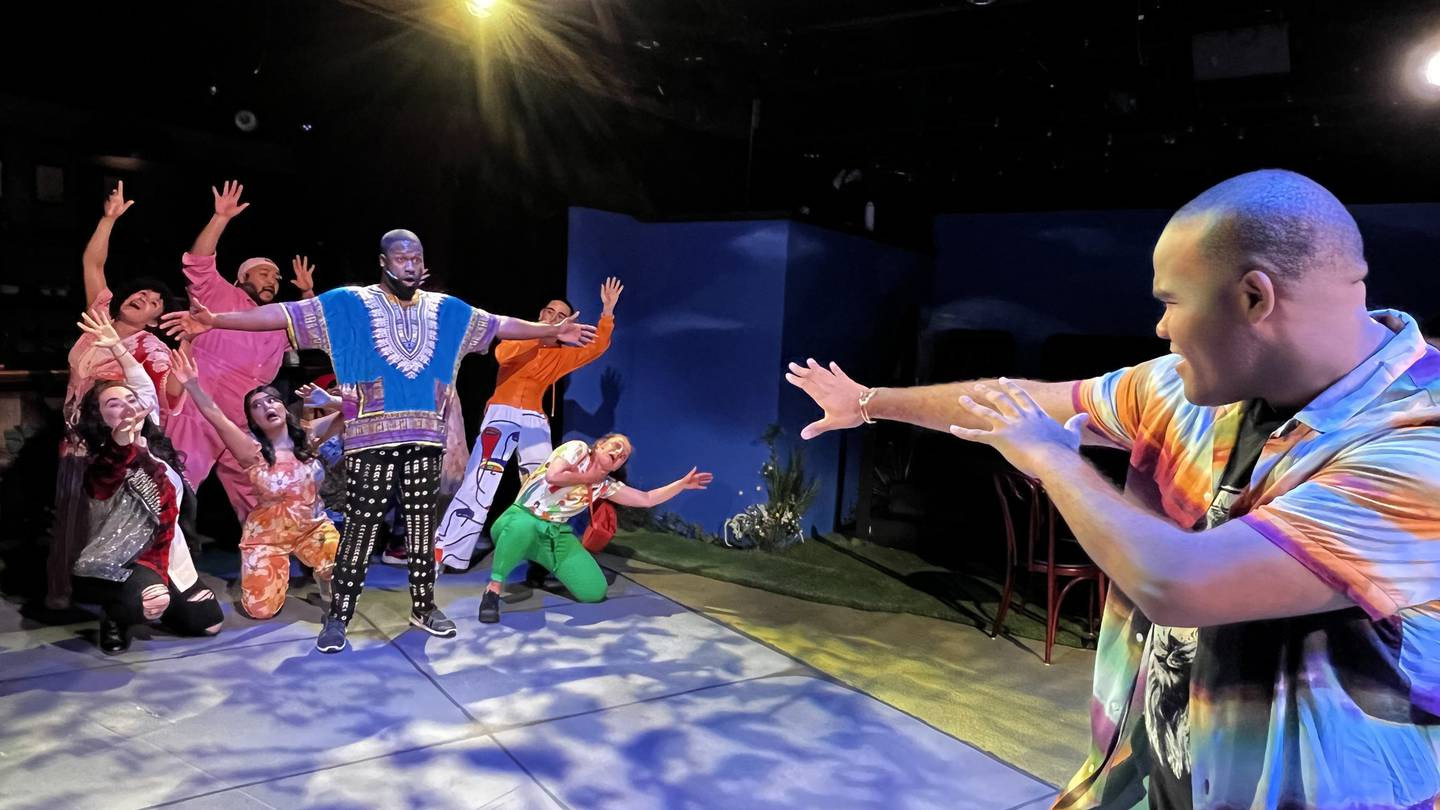
Austin Nelson, Jr., directs a parable with Matthew Hunter at the center.
One of the advantages of a storefront theater like Theo Ubique is the potential for an intimate connection between the cast and audience. One of director Christopher Pazdernik’s main conceits for Godspell is that the actors are all playing versions of themselves. The exceptional lead Austin Nelson, Jr., is referred to as Austin (rather than Jesus) as he manically conducts the rest of the cast in acting out parables. The evidence of Nelson’s conviction to his role is present in the layer of sweat that streams down his face from beginning to end. Anna Marie Abbate is referred to as Anna Marie (rather than Judas or John the Baptist), and she plays the role with commendable subtly, displaying skepticism toward Austin’s teachings that foreshadows the character’s later betrayals. The entire cast is given a great freedom in acting out the parables, and they often insert modern allusions for comedic effect.
The set is a path running across the floor creating a perception that the characters are meeting in a park, and the audience are passersby who cannot help but watch the scenes emerging before them. The main cast of 10 manages to perform intricate choreography that never feels limited by the long, narrow shape of their stage, but the most significant highlight is the singing. Each of the 10 leads performs a song beginning with Izzie Jones’s infectious “Day by Day.” Matthew Hunter is another standout using powerful lead vocals in “Light of the World” before sending the audience into the intermission. All told, Godspell succeeds beyond expectations at using its small space to provide a memorable experience for its audience, who is close enough to touch the action.
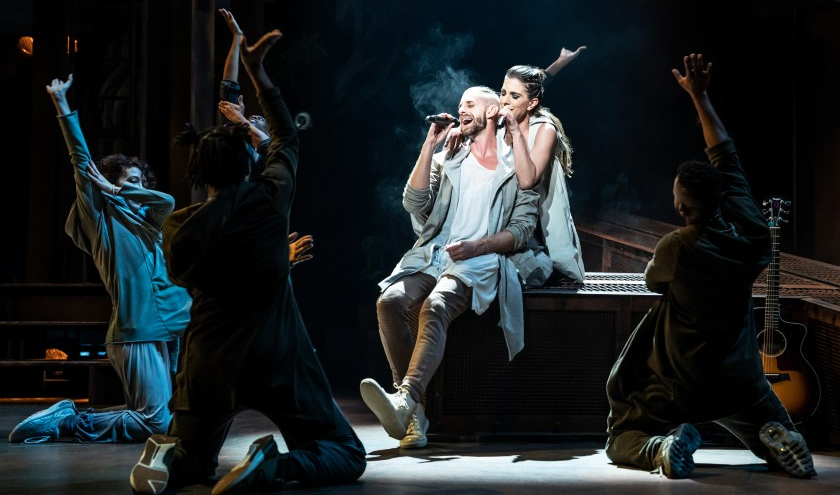
Jesus Christ Superstar, on the other hand, seems to be working toward the opposite ambition of isolating its audience from the emotions of a powerful musical. Early on, I realized that the presentation was more consistent with a rock concert than a performance of musical theater. The lead actors held microphones and often played guitar during their solos (remaining mostly stationary to the action), which is an interesting idea for a rock opera. However, in practice it led to a sense that each song was its own separate entity. Therein lies the main problem with this production. When the talented Jenna Rubaii as Mary sings a countrified version of “I Don’t Know How to Love Him,” she is more reminiscent of Carrie Underwood singing on stage rather than a character dealing with complex issues. Similarly, Aaron LaVigne as Jesus seems to be channeling Steven Tyler during “Gethsemane” (known by the repeating lyric “I’d Want to Know, My God”). He demonstrates his frustration at God by throwing the microphone stand upstage, but such antics are a distraction when the song itself—usually my favorite in the musical—communicates so much about Jesus’s mindset. Omar Lopez-Cepero as Judas focuses more on jumping around his significant vocal range than articulating what Judas had to say. What astonished me most was I left the theater not humming a song, which was far from the case after my two viewings of the superior 2017 production at the Paramount Theater.
Aaron LaVigne (Jesus) & Jenna Rubaii (Mary)
The concept is consistent with the origins of this official 50th anniversary tour, which began at the open air theater at Regent’s Park in 2016, and what I sat through in Chicago would have worked well in an outdoor amphitheater with half the seating of the Cadillac Palace. At the very least, the opening chords of the overture would have been less ear-splitting in their volume. This production is not unbearable, but it needed someone at some point to consider that less can be more when starting with a compelling story and a full roster of memorable songs.
Both Godspell at Theo Ubique and Jesus Christ Superstar at the Cadillac Palace run through July 31.
Back in the mid-1980’s, Andrew Lloyd Weber seemed to have a Midas touch that would never fade. Just looking at my own history of musical viewing reveals a giant Lloyd Weber fingerprint: Joseph was the first professional show I even saw (at the Marriott Lincolnshire), and not long after Cats was my first big-budget, downtown musical. Soon enough, Phantom arrived at the Auditorium with a massive traveling show, and it stands in my memory as the first show I left disappointed following tremendous hype.
Richard Bermudez, Addie Morales & Sean MacLaughlin
Disney’s Frozen continues its run at Chicago’s Broadway Palace through January 22, and it is worth seeing not only for the theatrical effects but also for the songs and story. Seeing Frozen led me to consider the progression of musicals from Disney Theatrical Productions, which began its Broadway affiliation more than 25 years ago with the premier of Beauty and the Beast.
This post will look back at the 11 Disney Theatrical musicals that I have seen. For a more complete list including shows in production, check out this link. In addition to ranking the musicals, I am also going to look at each musical’s role in the 25-year progression of Disney’s theater arm.*
Few experiences in musical theater can match the exhilaration felt by the audience and the performer during a remarkable solo. The best of solos – the true upper-echelon – provide a deep insight into not only the character’s mind but also the unique world in which he/she lives.
For this blog, I am going to focus on some of the best solos in which female performers put everything on the line. They are experiencing some form of crisis, and by the end of the song the character’s inner turmoil reverberates through our brains as much as the song’s melody. Some of these songs are recognized Broadway canon, but a few are more unique to my tastes and memories.
I could not find any quality photos from “Acid Queen” in the original Broadway run, but I do vividly remember the Gypsy’s bright yellow dress.
The Who’s Tommy was my first Broadway musical, an interesting choice for a sheltered middle-schooler more familiar with REO Speedwagon than The Who. I don’t remember if I even knew what “dropping acid” meant when I walked into the theater, but I sure knew by the number’s end as the silhouetted Gypsy shoots heroine into her arm. At intermission I peppered my mother with questions about how “Acid Queen” fit into the plot, and she responded, “In the 60’s, some people just liked to write songs about drugs.” Years later, as I found myself listening to this song on near repeat (maybe even belting along when I was alone), I realized that the greatness of “Acid Queen” is that the performer’s manic intensity is an embodiment of the character’s addiction. The Gypsy needs Captain Walker’s money, and to get it she is willing to “tear [Tommy’s] soul apart.” “Acid Queen” is the Gypsy’s only song, yet it serves as the rock bottom of the psychedelic experience that is Tommy’s journey.
Polly Bergen’s performance as Carlotta is immortalized in her performance at the 2001 Tony awards. The main link (which is the full song) is from the Drama Desk Awards.
The 2001 Tony Awards were dominated by The Producers, which set the record by winning 12 Tony Awards, a sweep of every musical category except Leading Actress. However, I contend that amid all the hype was one of the greatest gaffs in Tony Awards history. Namely, the late Polly Bergen should have beaten The Producers and won Best Featured Actress in a Musical for her performance of “I’m Still Here” in the Roundabout revival of Follies. As the title implies, “I’m Still Here” is a tour-de-force number. Sung by the character Carlotta Campion, the aging actress tells the story of career setbacks and humiliations articulated by some of Stephen Sondheim’s most glorious lyrics (“First you’re another sloe-eyed vamp / then someone’s mother, then you’re camp”), and ultimately her success is attributed to the fact that she relied on no one but herself. Bergen’s performance was a lightening-in-a-bottle moment followed of waves of applause that started thunderous, then died down before reigniting multiple times, ending only after Bergen signaled her exit stage right.
Broadway veteran Charlotte d’Amboise gave a commanding performance as Cassie in the 2006 revival. The full 10-minute scene is linked.
A number of moving parts contribute to the anticipation of “Music and the Mirror.” Subtle inferences that Zack and Cassie have a troubled past build to a fever pitch when the two finally share a dialogue. With Cassie exposed on center stage and Zack unseen from his director’s booth, Cassie is forced to beg just to continue her audition: “I need a job. I need a job and I don’t know any other way to say it. Do you want me to say it again?” Once the music begins, an actress must convey the desperation of the lyrics (“Put me to work, you would think that by now I’m allowed. I’ll do you proud.”) over the increasingly intense trumpet flourishes and drum licks. Other characters in A Chorus Line sing about their love for dancing, but Cassie is in a higher plane: her need to dance is expressed in every step of the 5-minute dance solo. As a character, Cassie is extremely vulnerable, but when she dances she takes full control of the stage.
Patti LuPone performed as Joanne in the 2011 filmed version of Company, which also starred Neil Patrick Harris as Bobby.
My first exposure to this Sondheim classic from 1970 was, unfortunately, in the form of the Forbidden Broadway parody “The Ladies Who Screech,” which is more obnoxious than funny (although Elaine Stritch’s rendition does become a bit screechy). What I have since discovered is that the extended belting at the end of the song (“Everybody rise. Rise. Rise, rise.”) is the musical embodiment of how Joanne perceives her own existence – she is bored, trapped in a tedious life with little to drink to beyond wealthy women who hide their own banality by shopping and taking art classes and (of course) meeting for lunch. The lyrics for “The Ladies Who Lunch” provide opportunity for each actress to tell a unique story. The best interpretation belongs to Patti LuPone, but don’t discount the Camp version in which a teenaged Anna Kendrick accentuates her anger by shattering her own martini glass.
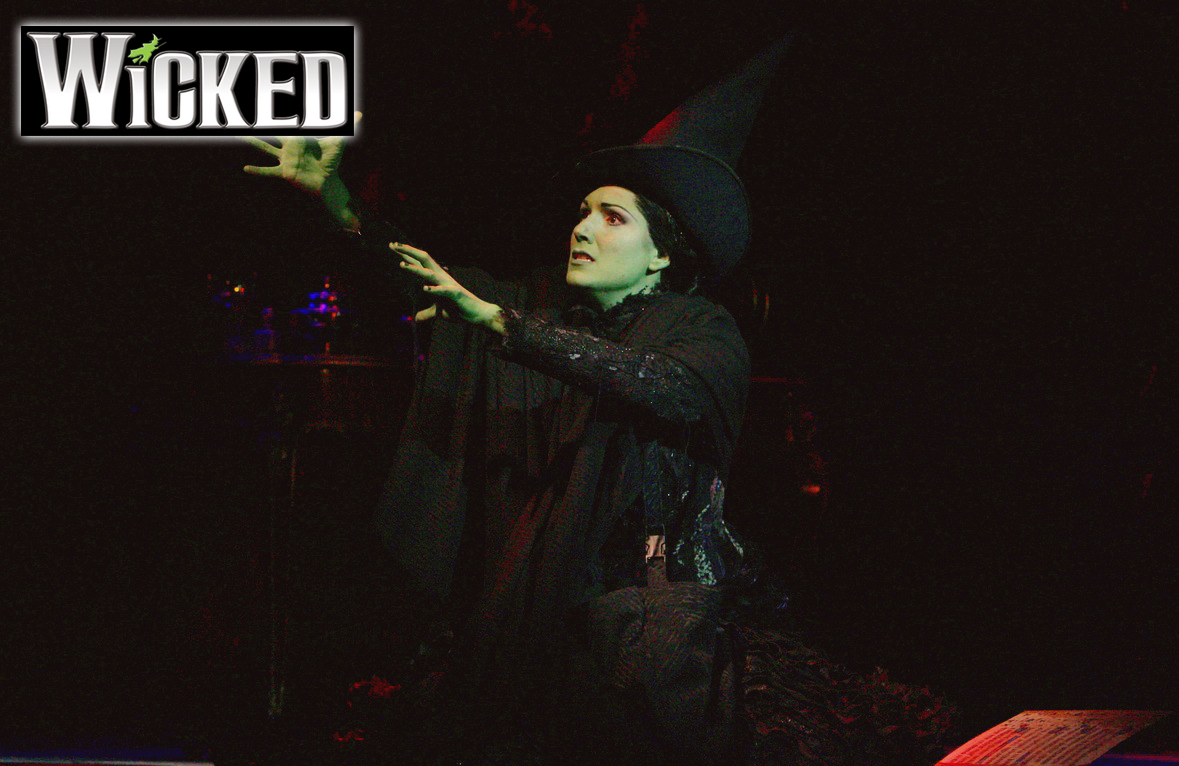
I have seen many actresses perform Elphaba, and Stephanie J. Block was my favorite. She is seen here reading from the Grimmerie during “No Good Deed.” The main link is Shoshana Bean performing.
The first act of Wicked focuses heavily on plot development, moving from Elphaba’s birth to her renunciation of the Wizard. The second act of Wicked slows the pace and emphasizes Elphaba’s internal struggles as she becomes The Wicked Witch, and the anchor of that second act is “No Good Deed.” Beginning with a rhythmic chant of magical words, the song lulls the audience into Elphaba’s turmoil before Stephen Schwartz’s lyrics expose the frustrations of her failures. When Elphaba sings, “One question haunts and hurts / Too much, too much to mention. / Was I really seeking good / Or just seeking attention?” Schwartz manages an ingenious summary for Gregory Maguire’s novel. The musical is lighter in tone than its source material, but “No Good Deed” creates a momentary glimpse into the question surrounding Elphaba’s life: was she predestined toward wickedness, or is her wickedness a result of her own actions? For both melody and emotional impact, “No Good Deed” is the best song in Wicked – greater even than the more popular “Defying Gravity.”
What it’s about: working hard but still getting nowhere
Tanya Pinkins starred in the original 2004 production of Carline, or Change, taking on one of the most physically and emotionally grueling roles in musical theater.
On my last viewing of Caroline, or Change, a brilliant 2018 collaboration by Timeline and Firebrand theater companies, I had a distinct lyric in my head at the start of intermission and even at the end of the show. Anchored by a rhythm reminiscent of the repetition of a basement dryer, Caroline sings, “And I am mean and I am tough but…/ Thirty dollars ain’t enough./ Thirty dollars ain’t enough.” This is an anthem for Caroline Thibodeaux, a maid in 1963 Louisiana struggling to support three children on her dismal salary (her oldest son is in Vietnam). This opening song with lyrics by Tony Kushner and music by Jeanine Tesori combines the soul of blues and the rigors of opera. Caroline’s tribulation is to hold tightly to a world which stacks the odds against her while knowing that she cannot last much longer. Caroline is one of the most difficult parts in any musical, and I have been very fortunate to see Tonya Pinkins (2004), E. Faye Butler (2008) and Rashada Dawan (2018) each excel in the role.
Kelly Felthous starred in Paramount Theater’s exceptional 2018 production of Cabaret. The main link features the late Natasha Richardson in a rendition of “Cabaret” that demonstrates the depth and versatility of the titular song.
I remember the awe I felt upon seeing the song “Cabaret” performed live for the first time. This was the 1998 Broadway revival at Studio 54 and Molly Ringwald (performing in 2002) was one of many capable actresses to step into the role of Sally Bowles. I was well acquainted with the song and understood it to be a celebration of life: “Come taste the wine, / Come hear the band./ Come blow a horn,/ Start celebrating;/ Right this way, your table’s waiting.” In fact, Liza Minnelli’s movie performance (directed by Bob Fosse) is an ode to exuberance. Imagine my shock upon seeing that this number had been completely turned on its head for the revival. Gone was the carefree ignorance of the growing Nazi presence. It was replaced by Sally clinging to her last thread. The world is crashing around her, and suddenly the morbidity of a song about a deceased prostitute/roommate is foreshadowing the oncoming destruction – a calamity that Sally is unlikely to survive. The magic of “Cabaret” is that the song is remarkable either way. It can be a boisterous drinking song or a sad commentary about futility.
Thanks for reading. Theater was all but nullified for most of 2020, but I am hopeful that the arts will make a slow reemergence in 2021. If you have other favorite female solos, post them in the chat. I am planning on posting in the near future a similar blog featuring favorite male solos.










 theater in chicago reviews