Satchmo at the Waldorf explores the life of Louis Armstrong on many complex levels: the personal, the professional, and the historical. Not surprisingly, the stand-out moments in this fantastic one-man show occur when Barry Shabaka Henley (playing Armstrong and a few other roles) is in the closest proximity to Armstrong’s music.
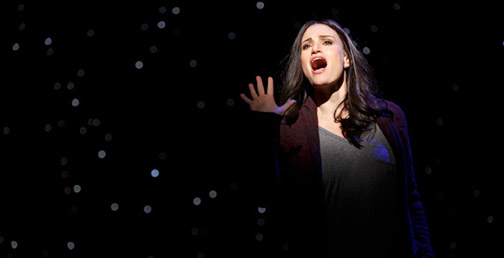
The website for the touring company of If/Then boasted that it was the first Broadway show to begin its tour with the principle cast intact. That claim is a thin sugar coating over the bitter reality that the only draw to this misguided musical is its principle cast—specifically Idina Menzel.
Million Dollar Quartet has been a gift to the Chicago Theater community for eight years. Having seen Million Dollar Quartet twice before, I needed to catch the excitement once more before it closed its doors on January 17, and indeed this ode to rock ‘n’ roll’s early years improves with each viewing.
The disgraced politician at the center of Bruce Norris’s Domesticated believes that he is a victim—a victim of natural biological urges, a victim of an anti-male society, a victim of the laws of physics.
Following a quick multi-media presentation on sexual dimorphism (that highlights gender dominance in a series of non-human species), Domesticated begins with the resignation of an urban politician named Bill (Tom Irvin) following a scandal that involves Bill injuring a teenage prostitute in a hotel room. Regardless of whether Bill pushed her or she fell by accident, she is in a coma and Bill must leave public service. Bill’s embarrassing inability to stick to his script as he meanders between public apology and incoherent justification of his actions is highlighted by his wife Judy (Mary Beth Fisher), who stands beside him with the icy stoicism.
Mary Beth Fisher, Tom Irwin, and Mildred Marie Langford
This spectacular year in Chicago theater featured many shows with social conscience along with the usual crop of musical revivals. Here are my picks for the top 10 Chicago shows in 2015:
Tiffany Topol, Jess Godwin, Bri Sudia, and Johanna McKenzie Miller
Joanna McKenzie Miller was perfectly cast as the lead of this production about Catherine Reed, a young mother who bonds with her fellow workers at Chicago’s Radium Dial Company. The four women’s friendship emphasizes the tragedy as each falls sick and dies after decades of licking brushes lined with radium. The minimalist set and costuming were a perfect match for the subdued but haunting score.
Being a fan of puppetry, particularly the use of puppetry to push boundaries, I was excited for my third show—the comedy Hand to God. In fact, Hand to God provided some immediacy for this vacation as it is closing on January 3.
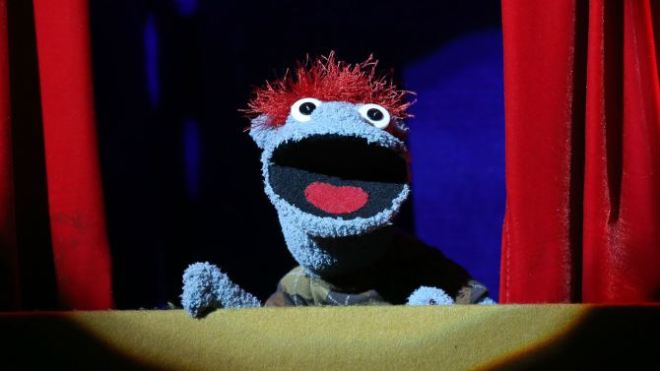
Tyrone in his opening monologue.
Tyrone—a loud-mouthed, violent, and possibly demonic hand puppet—begins and ends the play with hilarious monologues about the nature of evil (spoiler alert: it’s humans who created evil… not the other way around). Steven Boyer keeps his hands moving at light speed as Tyrone rants, raves, and attacks both his ventriloquist Jason and the four other characters in this outstanding ensemble cast.
I continued my tradition of visiting Manhattan for the weekend prior to Christmas. None of this year’s shows inspired the same I-need-to-fly-back-to-New-York-to-see-this-show-again reaction that I had after viewing Michael C. Hall in Hedwig and the Angry Itch, but all four were strong Broadway offerings.
I started with Fun Home, the well-deserved winner of the 2015 Best Musical Tony (considering that the runner up was Something Rotten, all theater-goers owe Fun Home a debt of gratitude). I did my homework by reading Alison Bechdel’s graphic novel prior to the show, and I was surprised Michael Cerveris’s portrayal of Bruce Bechdel involved much greater vulnerability than I had interpreted from the book.
Gabriella Pizzolo stars as Small Alison. The adult Alison (Beth Malone) watches and remembers as she tries to create visuals to capture her difficult relationship with her father.
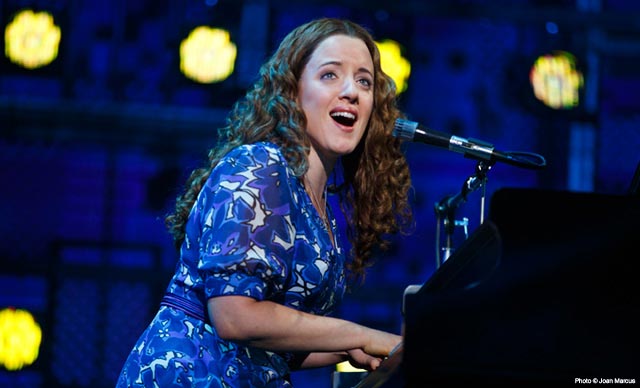
The earth doesn’t quite move during Beautiful despite every attempt to turn Carol King’s life into the next great biopic musical.
Abby Mueller is based in New York, but she has starred in enough Marriott and Drury Lane productions that can be considered a Chicago actress.
Like other works of the genre, King’s music is presented in an order than best represents a world in transition. Book writer Douglas McGrath does his best to add drama to the story of a hard-working songwriter who was accepted into the world of rock and roll with relative ease. King jumped on the runaway train that was the rock music industry at just the right time, and much of the action relates to the frantic pace with which King needed to produce hits while knowing that hot new songwriters were less than a step behind.
At a certain age during childhood, we start to devote a small amount of attention to the media. This awareness of newspaper headlines and TV soundbites begins before we realize that history is not just Egyptian pyramids or the Civil War or Kevin Arnold in The Wonder Years.
Kevin Clash, the puppeteer behind Sesame Street’s Elmo, stated in a Nightline interview that children are not surprised to see a large man in his 50’s standing behind his creation, moving his mouth in sync with Elmo. “They don’t look at me,” he says.
Rough House, a company specializing in using puppetry to create unique theatrical experiences, builds upon the same phenomenon throughout their original show Sad Songs for Bad People: A Puppet Play. From the start of the first musical number—the betrayed-lover-turned-murderer ballad “Delilah”—eyes are glued to a felt-faced lounge singer narrating his tale beside a screen where silhouette puppets present the action. Watching the actors is fun, but the focus always shifts back to the life that they bring to each puppet through choreographed movement.
Kay Kron, Maddy Low and Claire Saxe use humanette puppets for the “Teen Tragedies” compilation. Puppets designed by Grace Needlman and Cammi Upton.
Sad Songs for Bad People, featuring puppet design and direction by Mike Olean, delivers on its promise for a night of music, puppets, and murder. The nine songs presented by the cast of six musicians and puppeteers are stitched together by connections to death, each involving a very different visual experience. Continue reading “Sad Songs for Bad People: A Puppet Play — Rough House (11/21/15)”→






 theater in chicago reviews